Sunday, December 17, 2006

Antibiotics Cure Stds

Arnolfini Marriage


We are facing a key work of a author who led the vanguard of his time painting in his country. Jan Van Eyck, along with his brother Humbert, one of the leading figures in the painting movement we know today as "Flemish primitives."

emerged in the fifteenth century Flanders appear as an innovative group that introduces new themes and values \u200b\u200bin painting. Flemish society of that time finds itself in a process of industrialization unknown in the rest of Europe. The weaving industry of wool imported from England, turned into a very expensive cloths sold worldwide, has generated a rich bourgeois class through the process that requires a specific art religious art differential prevailing in the rest of the known world . The wealthy merchants of the Netherlands to claim Pictures to enhance his vanity and decorative elements to beautify their new palaces. For this exploit the best of local tradition: the love of the landscape and still life, issues related to the simple life and naturalism Germanic art in this lawsuit are a perfect breeding ground for development. On the other hand, the introduction of oil painting on panel of flamenco artists provides a suitable tool to fully express these issues and to highlight the new innovative spirit.

week's work is a paradigmatic example of the artistic moment. This is an oil on board of 80 * 60 centimeters. The scene is a moment of the ceremony as a liaison between the rich Italian merchant Arnolfini and his young wife, of Italian descent as well. The picture is conceived as a kind of public marriage certificate which attests to the painter himself as a witness (signing the work in the back wall between the mirror and the lamp and adding the phrase JOHAN VAN EYCH Fuit HIC).

Forms are defined by the contrast of colors and lights, the line has disappeared as an essential element to separate volumes. The drawing is strong and firm.

warm colors predominate so that the green dress the bride stands out especially. The set is riddled with realism and volumes are perfectly modeled by soft degradation.

lights and shadows are interspersed to give a heightened sense of depth by the vanishing of the window and architectural elements which perspective is introduced in a line similar to that described by the work of Brunelleschi in Italy .

The main figures are arranged next to each other as required by the situation portrayed suggested holding a wedding ceremony. In all other secondary figures abound scene laden with symbolism: the dog symbolizes fidelity and conjugal love, the shoes could symbolize the sanctity of marriage, the fruit next to the window means fertility or original sin.

The thoroughness of the work of Van Eyck is evident not only in the naturalism of his portraits of the parties or the detail put into the representation of all elements of the painting, but finds its ultimate expression in the hard work carried out in the mirror at the back of the scene, despite its small size contains clearly identifiable, the representation of ten scenes from the life of Christ and a view of the scene depicted from which we can observe the Arnolfini and the painter himself along with a wedding guest.

Saturday, December 2, 2006

Drywall And Gluten Intolerance

THE WEEK FROM 20 TO 24 NOVEMBER


The work This week is a fresh. The fresco technique consists of painting on freshly plastered walls with a mixture of sand and lime while still wet. The pigments are dissolved in lime as well, so that permeate deep into the wall gaining in strength. The drawback of this technique is that the colors are expanded in a way that is difficult to control, so that you can not specify too much detail.

The drawing is full of strength and simplicity. A thick black line delineates the schematic forms and simplicity of the volume conveys a pure energy, almost childlike, full of candid spirituality.

The colors are flat and fundamental. Deep blue used in contrast to pure red and yellow and the author shows at no time intended to degrade the lights to try, using leftover modulated recreate the feeling of volume.

The resulting light is diffused, omnipresent, that invades every space and void any possibility of shadow.

Both these grounds, and the absence of benchmarks for the same configuration resulting group of characters, the play lacks depth and perspective. Strongly illuminated figures and the absence of lines or landscape features that suggest a fund plunge us into a two-dimensional world is not ashamed of his condition two-dimensional. Moreover, the use of a half-dome apse and crown it as the basis for the development of this work and the working optical resolution of the problems posed by forms of support are an unexpected skill in the artist.

composition of a Byzantine influence is as easy as one would expect in a work of this era and style. The characters, the virgin with the child and the three wise men, superimposed on the wall in the same plane. The size difference between Mary and the Magi do not follow set any perspective, but the intent of highlighting the mother of Jesus without regard to naturalism would reject such disproportion.

The work at hand is, therefore, the characteristics identified, a Roman fresco XI century or the beginning of XII. In particular, we can say that this is the apse of Santa Maria de Tahull, in Catalonia.

HISTORICAL CONTEXT.

The fear of the millennium and the end of the world that it would, forged in the minds of Christians throughout the West a twisted view of life and divinity. In gratitude to God for his merciful forgiveness of late saves us in extremis the end of the world, Christians embark on a headlong rush of pity and sample submission to the divine. This devotion evidenced in the building industry that has fever to invest all their efforts in raising contractionary dark temples, squat and solid, true God Castle. Fully medieval art of eleventh and twelfth centuries reached its peak in the Romanesque. The philosophical figure of St. Augustine casts a long shadow on the art of the early second millennium. His exaltation of the soul and contempt for the material has penetrated deeply into society and the artist takes the time to reject naturalism and embrace a figurative expressionist style and prone to abstraction that borders on the puerile for its ingenuity.

Saturday, November 18, 2006

A330 Fuji Mechanical Drawing

WEEK FROM 13 TO 17


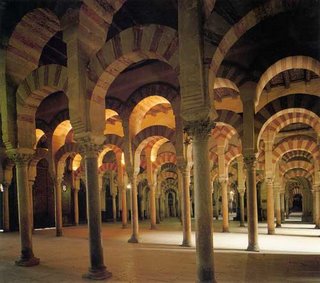
This is a building impossible to confuse and whose image is engraved in the memory of all. Is the Mosque of Cordoba.
all know that this is a building that mixes different types of materials: marble columns and stone pillars and walls with brick arches and wooden coffered ceilings that crown the first ships.
His original destination of a religious order, has endured through the centuries but is now Cathedral Catholic.
are, without doubt, its columns and arches that make the most characteristic elements of this building. The columns that we see correspond to the first part was built on the ruins of the church of San Vicente. It's easy to tell by looking the Corinthian capitals and the bases of the columns because these items are material hauling and old buildings from Roman and Visigothic English. In subsequent extensions, the columns have no bases and capitals, schematic, simulation of the above, be of the order that we call "Córdoba." But most striking are so characteristic overlapping arches. The arches are made with brick of two alternating colors in imitation of the rig used by Roman aqueduct builders of the Miracles of Merida. To achieve greater elevation, on two separate columns have been built pillars that bend the pole height.
walls of stone, are marked by powerful buttresses and vain but not too many doors abound (five on the west side and nine in the East, the Almanzor), but they remain closed to the interior environment is, Although artificial lighting, a bit bleak. Cover is
lintel in most of the building. The roof is wooden in the first three expansions and vaulted stone of Mansur. The Christian also uses wood in the Gothic vaults alternated with nerves and stone. The cruise is crowned by a dome Renaissance while the choir and transept, billing Renaissance / Mannerist are covered by barrel vaults. Outside, the Muslim has a provision of pitched roofs on each ship. The Gothic cathedral displays its characteristic appearance seen from the air showing the characteristic buttresses.
On the Muslim side, the dome stands Mihrab Hisham II work beautifully decorated whose nerves are intertwined to form an octagon in the center.
The plant's main building, inherited from the Muslims, is rectangular, while the usual Christian work has a Latin cross with three naves and the transept more focused than in Romanesque buildings.
The decor is quite austere in exterior walls which include the door just to have some of the most characteristic elements of the mosque in Cordoba: the horseshoe arches, the Alfica on these and roll corbels (door San Esteban). Inside, we know most of the original furnishings have been covered by later Christian work, but the most striking element is found in the mihrab and dome decorated with beautiful glazed ceramic coated with gold by the Emperor Byzantine to the Emir of Córdoba.
The building in general is a work that has expanded in phases from mid-eighth century (Rahman I), the addition of new ships in the sg. IX by Rahman II, the expansion of Alhakem which is the last in a southerly direction and which is the most remarkable element of Alhakem Mihrab. The minaret is because Rahman III. The last extension (east) that extends the Qibla wall of the mihrab is decentralizing BOUT Almanzor in sg. XI.

Thursday, November 9, 2006

Gp1200 Wont Turn Over

WEEK OF NOVEMBER 30 OCTOBER TO 3 NOVEMBER

As we can see, this is a large-scale building in stone.
building function is religious, since it is a temple. The rig is isódomo
and consists of regular blocks. In the front we can see short-shaft columns and capital in the form of inverted truncated pyramid that we associate with Byzantine art. The decorative motifs on the capitals seem to plant type. The columns are grouped around the five-door jambs and are arranged in two tiers seem to have no real function sustaining, but rather decorative. The fact that the front shows five hits might indicate that the interior has five ships. The façade is preceded by a portico which reproduces the silhouette above the arches preceding the respective doors.


From the perspective of the photo, which boast several domes, plus the capital valued in the front, suggests that the building design is bizantina. Hecha esta observación podemos aventurar que la planta del edificio será de cruz griega y que sendas cúpulas culminarán cada uno de los cuatro brazos de la cruz y una nueva cúpula, de dimensiones mayores, coronará el crucero. Los brazos de la cruz estarán coronados bóvedas de cañón y los arcos utilizados son de medio punto.
La fachada presenta una decoración que revela la intervención de diferentes artistas a lo largo de un periodo de tiempo prolongado. Los elementos estructurales (las columnas de delgado fuste y los baquetones que flanquean los huecos) pertenecen al periodo original en el que se construye el edificio (siglo VI o VII dJC), los arcos que coronan el pórtico adelantado estás rematados por gambletes que tienen todo el aspecto de ser góticos y, probablemente datan de los siglos XIII o XIV. Los tímpanos de las puertas, embutidos en un nivel más profundo, aunque no es posible distinguirlos en la foto, sabemos que son obra del siglo XVII o XVIII de algún pintor de la escuela veneciana. El interior suponemos que estará profusamente decorado a base de mosaicos y será obscuro dado el escaso número de vanos que presenta la construcción salvo por las cristaleras que se aprecian en la parte superior de la fachada. Las imágenes que jalonan la parte superior de la fachada también delatan una procedencia gótica tardía.
Como hemos dicho anteriormente, la planta debe de ser basilical de cruz griega.
For all these reasons, the specific work we analyze is a prototypical example of Byzantine art. In particular, it is San Marco in Venice, sent work to build the early second millennium. At this time the love / hate relationship between Byzantium and the Serene is marking the lives of both states has left an indelible mark on the artistic conception of the Venetians. This influence is evident in the magnificent work uniquely designed to house the remains of San Marcos recently rescued by the army of the Doge after the conquest of Alexandria.

Saturday, November 4, 2006