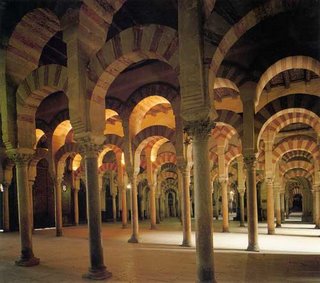
This is a building impossible to confuse and whose image is engraved in the memory of all. Is the Mosque of Cordoba.
all know that this is a building that mixes different types of materials: marble columns and stone pillars and walls with brick arches and wooden coffered ceilings that crown the first ships.
His original destination of a religious order, has endured through the centuries but is now Cathedral Catholic.
are, without doubt, its columns and arches that make the most characteristic elements of this building. The columns that we see correspond to the first part was built on the ruins of the church of San Vicente. It's easy to tell by looking the Corinthian capitals and the bases of the columns because these items are material hauling and old buildings from Roman and Visigothic English. In subsequent extensions, the columns have no bases and capitals, schematic, simulation of the above, be of the order that we call "Córdoba." But most striking are so characteristic overlapping arches. The arches are made with brick of two alternating colors in imitation of the rig used by Roman aqueduct builders of the Miracles of Merida. To achieve greater elevation, on two separate columns have been built pillars that bend the pole height.
walls of stone, are marked by powerful buttresses and vain but not too many doors abound (five on the west side and nine in the East, the Almanzor), but they remain closed to the interior environment is, Although artificial lighting, a bit bleak. Cover is
lintel in most of the building. The roof is wooden in the first three expansions and vaulted stone of Mansur. The Christian also uses wood in the Gothic vaults alternated with nerves and stone. The cruise is crowned by a dome Renaissance while the choir and transept, billing Renaissance / Mannerist are covered by barrel vaults. Outside, the Muslim has a provision of pitched roofs on each ship. The Gothic cathedral displays its characteristic appearance seen from the air showing the characteristic buttresses.
On the Muslim side, the dome stands Mihrab Hisham II work beautifully decorated whose nerves are intertwined to form an octagon in the center.
The plant's main building, inherited from the Muslims, is rectangular, while the usual Christian work has a Latin cross with three naves and the transept more focused than in Romanesque buildings.
The decor is quite austere in exterior walls which include the door just to have some of the most characteristic elements of the mosque in Cordoba: the horseshoe arches, the Alfica on these and roll corbels (door San Esteban). Inside, we know most of the original furnishings have been covered by later Christian work, but the most striking element is found in the mihrab and dome decorated with beautiful glazed ceramic coated with gold by the Emperor Byzantine to the Emir of Córdoba.
The building in general is a work that has expanded in phases from mid-eighth century (Rahman I), the addition of new ships in the sg. IX by Rahman II, the expansion of Alhakem which is the last in a southerly direction and which is the most remarkable element of Alhakem Mihrab. The minaret is because Rahman III. The last extension (east) that extends the Qibla wall of the mihrab is decentralizing BOUT Almanzor in sg. XI.
all know that this is a building that mixes different types of materials: marble columns and stone pillars and walls with brick arches and wooden coffered ceilings that crown the first ships.
His original destination of a religious order, has endured through the centuries but is now Cathedral Catholic.
are, without doubt, its columns and arches that make the most characteristic elements of this building. The columns that we see correspond to the first part was built on the ruins of the church of San Vicente. It's easy to tell by looking the Corinthian capitals and the bases of the columns because these items are material hauling and old buildings from Roman and Visigothic English. In subsequent extensions, the columns have no bases and capitals, schematic, simulation of the above, be of the order that we call "Córdoba." But most striking are so characteristic overlapping arches. The arches are made with brick of two alternating colors in imitation of the rig used by Roman aqueduct builders of the Miracles of Merida. To achieve greater elevation, on two separate columns have been built pillars that bend the pole height.
walls of stone, are marked by powerful buttresses and vain but not too many doors abound (five on the west side and nine in the East, the Almanzor), but they remain closed to the interior environment is, Although artificial lighting, a bit bleak. Cover is
lintel in most of the building. The roof is wooden in the first three expansions and vaulted stone of Mansur. The Christian also uses wood in the Gothic vaults alternated with nerves and stone. The cruise is crowned by a dome Renaissance while the choir and transept, billing Renaissance / Mannerist are covered by barrel vaults. Outside, the Muslim has a provision of pitched roofs on each ship. The Gothic cathedral displays its characteristic appearance seen from the air showing the characteristic buttresses.
On the Muslim side, the dome stands Mihrab Hisham II work beautifully decorated whose nerves are intertwined to form an octagon in the center.
The plant's main building, inherited from the Muslims, is rectangular, while the usual Christian work has a Latin cross with three naves and the transept more focused than in Romanesque buildings.
The decor is quite austere in exterior walls which include the door just to have some of the most characteristic elements of the mosque in Cordoba: the horseshoe arches, the Alfica on these and roll corbels (door San Esteban). Inside, we know most of the original furnishings have been covered by later Christian work, but the most striking element is found in the mihrab and dome decorated with beautiful glazed ceramic coated with gold by the Emperor Byzantine to the Emir of Córdoba.
The building in general is a work that has expanded in phases from mid-eighth century (Rahman I), the addition of new ships in the sg. IX by Rahman II, the expansion of Alhakem which is the last in a southerly direction and which is the most remarkable element of Alhakem Mihrab. The minaret is because Rahman III. The last extension (east) that extends the Qibla wall of the mihrab is decentralizing BOUT Almanzor in sg. XI.


.jpg)